Resources / Cash acceleration
The Accelerator · Terms
Why 1.5% Late Fees Backfire on Agency Cash Flow (And What Actually Works)
· 7 min read · Updated
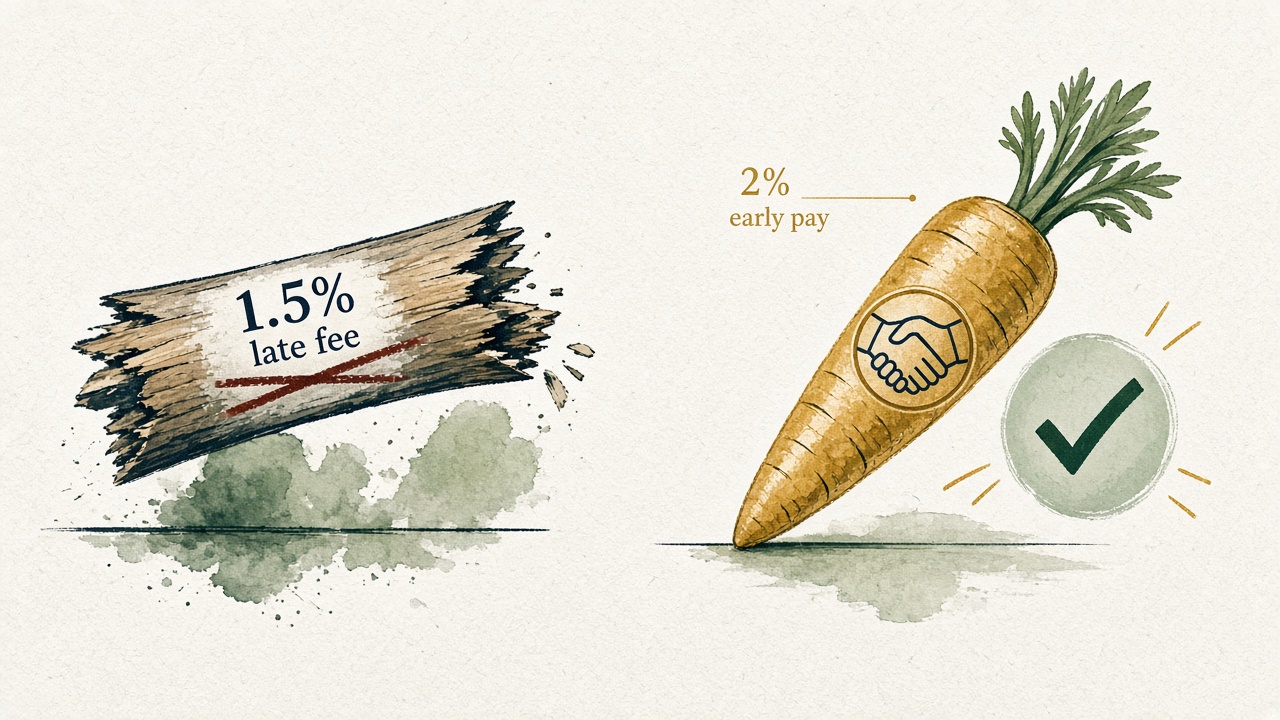
The 1.5% monthly late fee looks like discipline on a contract. On an enterprise remittance advice it looks like a line item AP is authorized to ignore. You do not collect it. You do spend political capital trying.
The late-fee illusion
Agencies add late fees because they want a consequence for overdue invoices. Treasury desks treat those fees as non-PO charges. If it was not on the original purchase order, it often cannot be paid without a new approval cycle — which is slower than the original invoice. The stick becomes another stall.
Why AP strikes the penalty
Three reasons the fee never lands when you try enforcing Net 30 with penalties:
- Procurement policy forbids paying amounts not on the PO.
- Controllers will not set a precedent that vendors can self-assess interest.
- The fee is smaller than the cost of a second approval, so they short-pay the principal and close the item.
You still have the original cash-flow problem. Now you also have a dispute on the remittance.
The relationship tax
The person who hired you is not the person who keys the payment. A late-fee notice hits the champion’s inbox looking like a collections letter. They spend political capital inside their own AP group defending you — or they start shopping for a calmer vendor. Enforcing Net 30 with penalties protects a clause and endangers the account.
Carrots over sticks
Corporate treasury already has a machine for this: early-pay programs. A 2% discount for settling this week is a return their cash team can defend. A 1.5% penalty for settling late is a vendor complaint they can delete.
Stick · struck off
1.5% late fee
- Not on the purchase order
- Needs a second approval cycle
- Hits the champion as collections
Carrot · bookable
2% if paid this week
- Treasury defends vs cost of capital
- One-click, time-bound offer
- Split 60/40 if the run is too large
Make the offer time-bound and one-click. Example: 2% if paid in 5 days, 1% if paid in 10, par if it rides the standard cycle. Treasury can drop the invoice into an earlier pay run because the discount funds itself against cost of capital.
When the balance is too large for one run, split it. A 60/40 milestone settlement gets cash moving without asking AP to champion a special full-pay exception. That is how you handle overdue invoices without ruining the relationship: give treasury a yes they can book.
DueBridge tie-in
Dynamic sliding-scale terms and 1-click split settlement.
DueBridge’s Accelerator puts a shrinking discount on the invoice the AP desk already has — not a new PDF arguing about interest. Debtor treasury gets 1-click settlement or a structured split. You recover liquidity from the next pay run instead of waiting on a penalty nobody will book. Policy sliders keep the offer inside what you will actually accept, so the incentive never undercuts the relationship.
Questions these searches are asking
Should agencies charge late payment fees on Net 30 invoices?
Usually no — not if the buyer is an enterprise AP desk. 1.5% monthly penalties are routinely struck from remittances because they were not on the purchase order. The fee rarely recovers cash and often creates a dispute.
How can you enforce Net 30 terms without late fees?
Use carrots: time-bound early-pay discounts (for example 2% for 1-click settlement this week) and structured split settlement. Treasury can defend a discount against cost of capital. They cannot easily book a vendor-assessed penalty.
How do you handle client overdue invoices without ruining relationships?
Keep the champion out of collections theater. Offer a shrinking discount or a two-part plan the AP desk can execute, and verify the open balance before every send so you never demand cash that already landed.